
Hugh Douglas Hamilton: A Genius in Rome
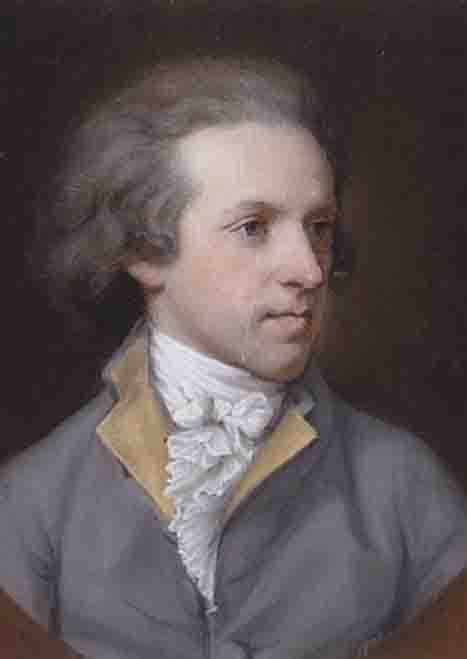
Hugh Douglas Hamilton, Self-Portrait (C. 1785-90), Pastel
Without a doubt, Hugh Douglas Hamilton was one of the finest, if not the greatest, Irish
portrait painters of the Georgian era, who excelled in both Pastel and Oils. He studied under
Robert West and James Mannin, both respectable artists in their own right, at the Dublin
Society School of Drawing in the 1750s. Interestingly, both West and Mannin taught the
artists George Barret Senior and Thomas Roberts, who became two of the finest Irish
Landscape Painters of the 18th-Century. After his training, Hamilton soon set up a business
as a portraitist in pastels, which proved to be highly successful. He left Ireland in the 1760s
for London, and in C. 1779-1780, he and his wife, Mary, and daughter, Harriott, moved to
Rome. He soon began to build a prominent client base, and quickly made many friends,
including with the great Neoclassical Sculptor Antonio Canova. They collaborated together,
and one of his best works during his time in Rome was a large pastel titled ‘Canova and
Henry Tresham looking at Canova's Cupid and Psyche’, which he painted between 1788
and 1789. It depicts the Irish artist, Tresham, looking at Canova’s model sculpture of the
classical tale, while Canova leans against the work with the chisel or hammer in his hand. It
is regarded as Hamilton’s ‘Roman Masterpiece’, and is now at the Victoria and Albert Museum. Hamilton was doing so well with commissions and selling his artwork, that he often complained to Canova about the heavy workload and the amount of large portraits he had to do.
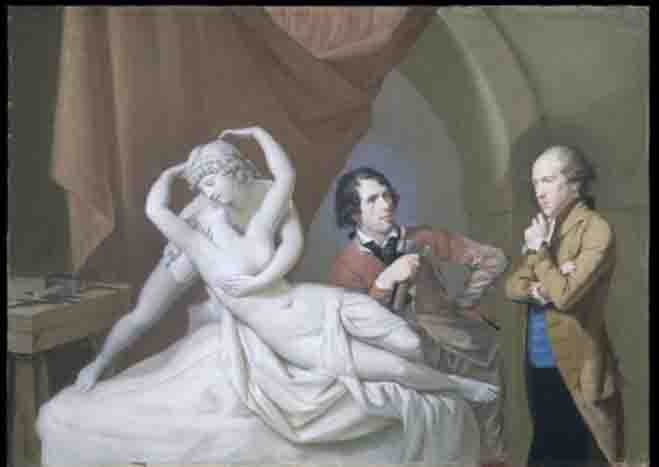
Hugh Douglas Hamilton, Canova and Henry Tresham looking at Canova's Cupid and Psyche (C. 1778-1779), Victoria and Albert Museum
On the recommendation of the sculptor and fellow artist John Flaxman, he turned to oils and started experimenting by painting small oval portraits in oil of English and Irish Visitors, and Grand Tourists, who visited Rome. In this sale, we have one of these early oval oils by him. It is a portrait of a fellow artist of Hamilton’s circle, probably Irish or English, who does not wear a wig, which is a rare occurrence during the period. Hamilton depicts him in a bust-like manner, with his natural hair tied at the back with a ribbon and let down, while he wears a brown or tan waistcoat, and a white cravat or linen shirt. Most men of middle-class or high status in the Georgian era wore wigs, and it is notable that Hamilton’s father crafted perukes, which were powdered wigs that were very fashionable during the time. What looks a quite simple composition, really isn’t, as Hamilton uses diff erent tones of white to depict the creases around the neck of the sitter, as well as the fold of the waistcoat, creases around the arms and the deft little linear strokes around the waistcoat, especially in the area of the arms.
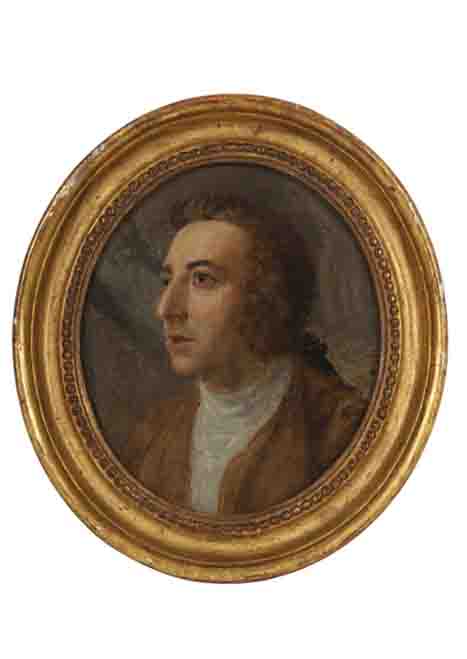
Hugh Douglas Hamilton, Portrait of a Gentleman in Rome (1782), Oil, Lot 981 in our Coolattin House Sale on October 7th
© Sheppard's Irish Auction House +353 (0)57 874 0000 info@sheppards.ie