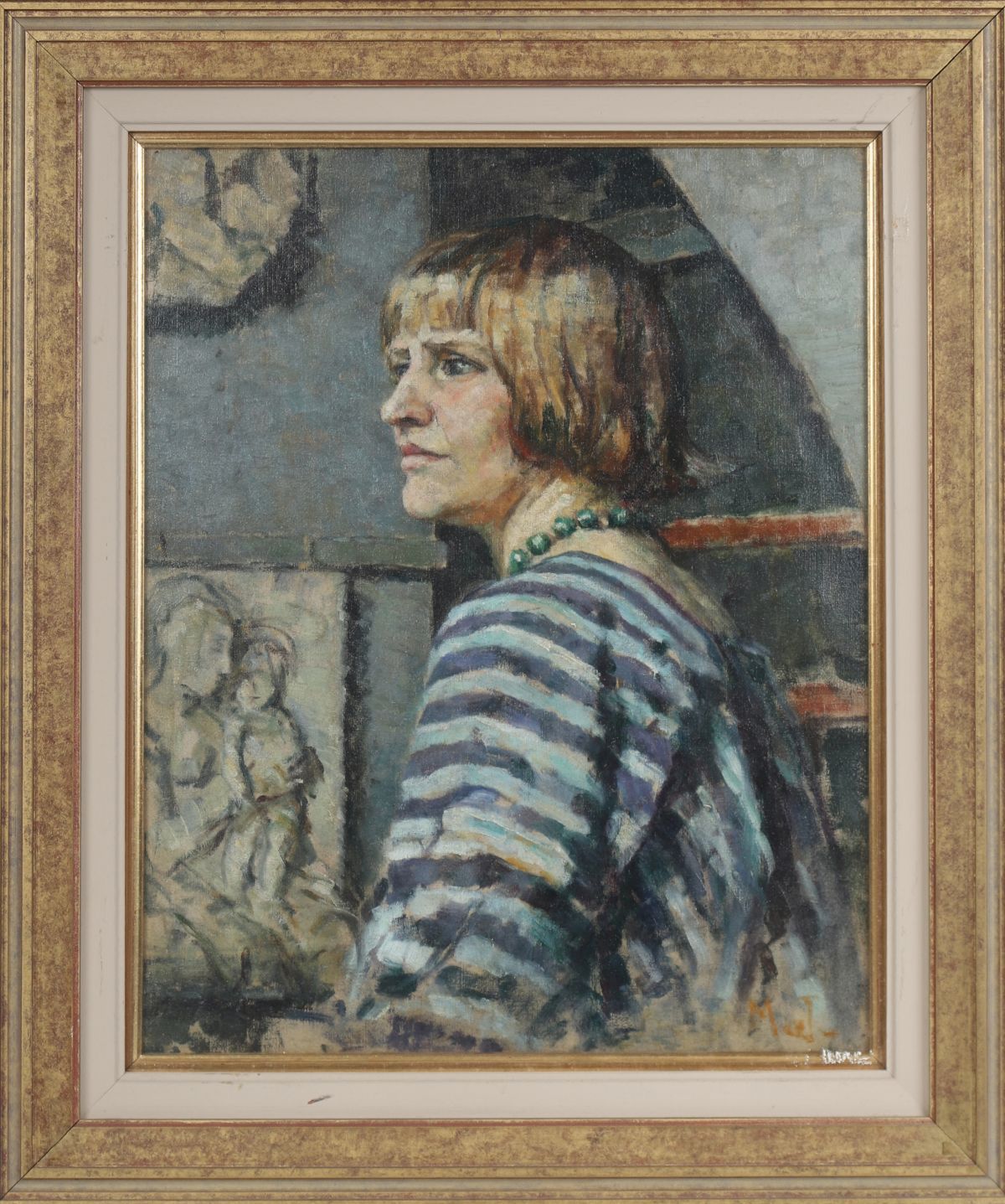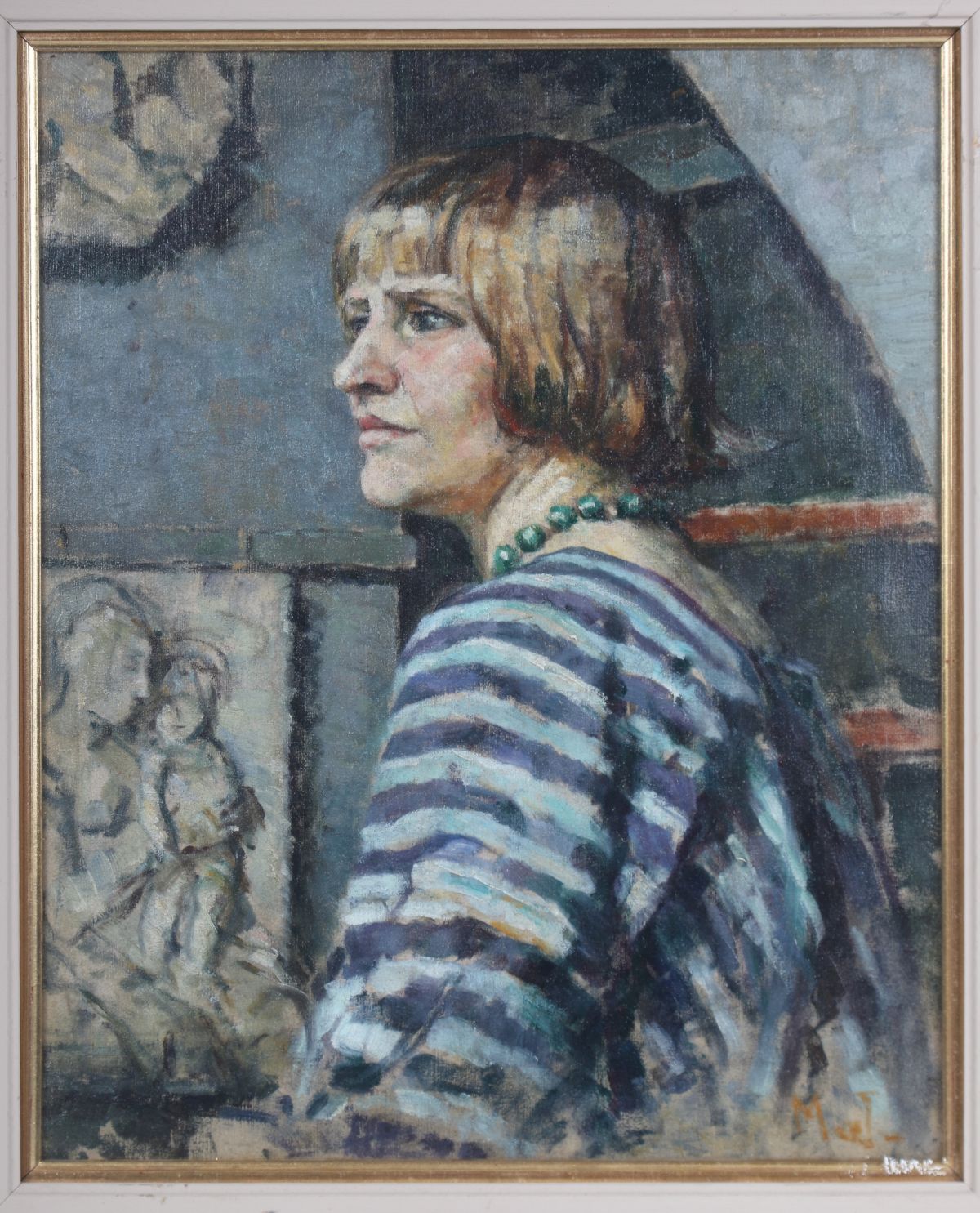
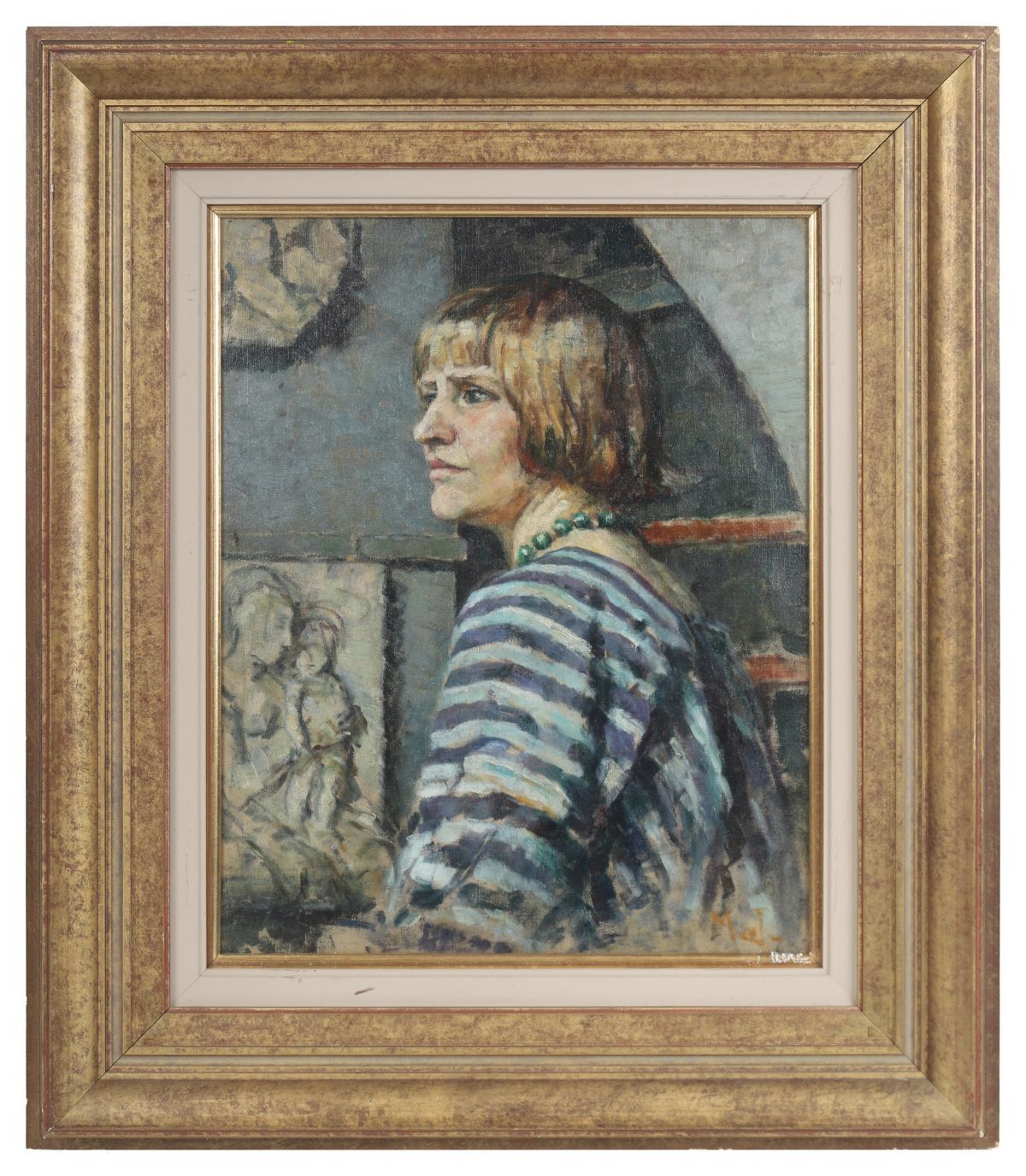
Lot 150 MAINIE JELLETT (1897 - 1944)
Title: Woman in a Striped Blouse
Medium: Oil on Canvas
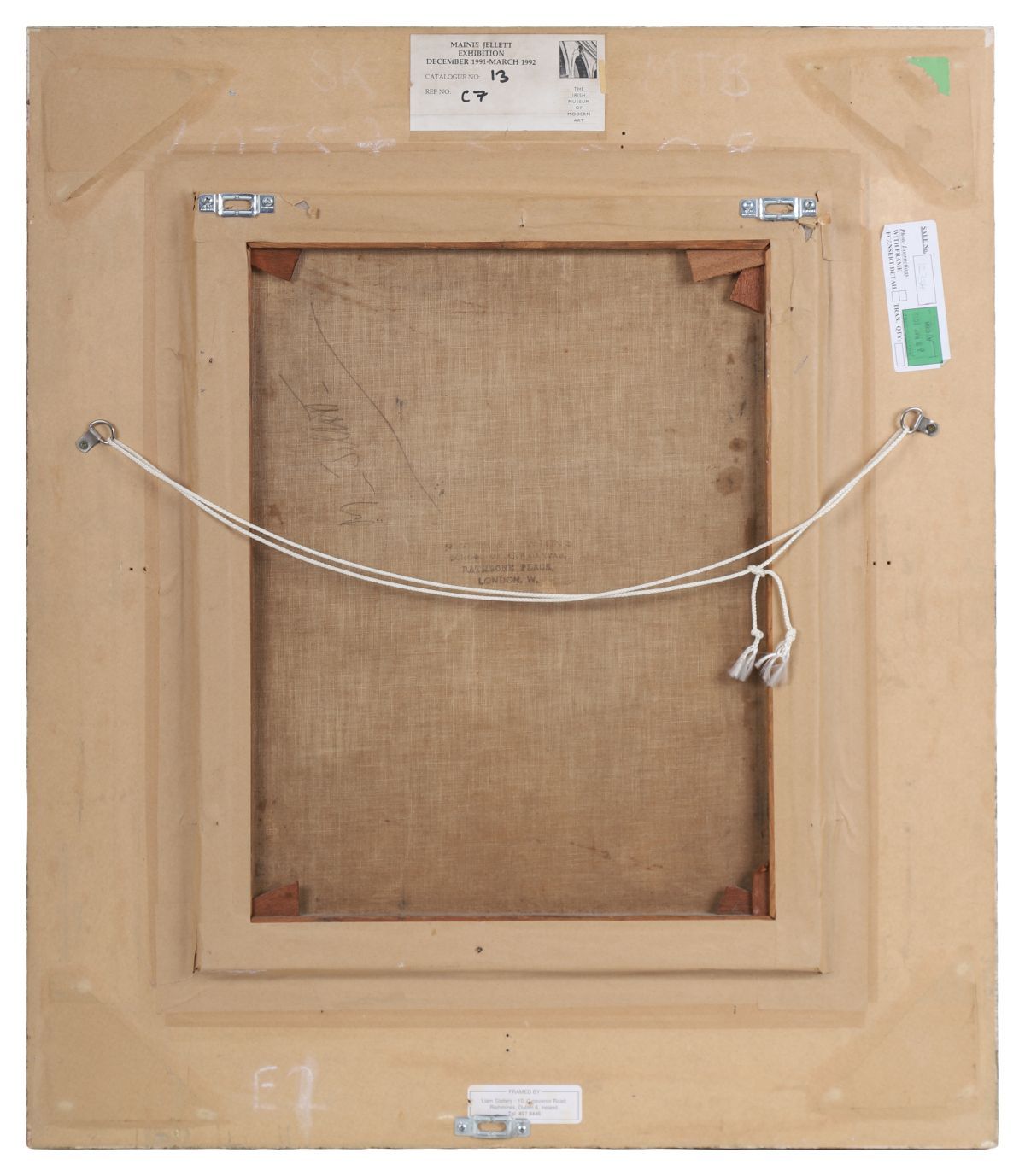
Signature: Signed with Initials Lower Right; Signed again Verso; Inscribed on IMMA Exhibition Label Verso
Provenance: Neptune Gallery, Dublin, 1974; Adam's, 'Important Irish Art', Dublin, 31 May 2017, Lot 130; Private Collection
Exhibited: 'Mainie Jellett 1897 - 1944', Neptune Gallery, Dublin, 12 September - 26 October,1974, Catalogue No. 9 (Illustrated in black and white in catalogue); 'Mainie Jellett Retrospective Exhibition', Irish Museum of Modern Art, Dublin, December 1991 - March 1992, Catalogue No. 13
Literature: Bruce Arnold, 'Mainie Jellett and the Modern Movement in Ireland, Yale University Press, New Haven and London, 1991, p. 25 (Illustrated figure 30); Bruce Arnold, 'Mainie Jellett', IMMA, 1991, p. 47 (Full page illustration)
Notes: The sitter in the present work is believed to be a fellow student at the Westminster Technical Institute, where she attended between 1917 and 1919. She later wrote of her time there, 'for the first time drawing and composition came alive to me'.
Framed
Woman in a Striped Blouse is one of several portraits that Mainie Jellett painted while working under the celebrated artist and teacher Walter Sickert at London’s Westminster Technical Institute in 1918. Working in a range of pencil, pen, watercolour and pastels, her figure studies and portraits from this time are often quickly and lightly sketched, and few were worked up into final canvases. Woman in a Striped Blouse is exceptional in that it was completed as a painting but one that retains much of the freshness of Jellett’s drawings and sketches. Unlike much of her life room work, the figure here is believed to be a portrait of a fellow student. First exhibited at the 1974 Jellett show in the Neptune Gallery, it has since been in a private collection. Today, Jellett is remembered as a brilliant painter committed to an uncompromising vision of abstraction, who shaped the course of modernism in Ireland like few other artists.
Although widely derided when first exhibited in Ireland in the 1920s, Jellett’s exacting, austere Cubist compositions still feel radical. They are widely collected and continue to feature prominently in surveys and studies of international abstract art. But before Jellett developed her theory of Cubist abstraction while working in Paris during the roaring twenties, she had trained in Dublin and London and produced a brilliant body of realist work that remains little known. It is to this period that Woman in a Striped Blouse belongs. Showing prodigious talent in art as well as music as a child, Jellett’s inclinations were nurtured by her parents. She had some initial lessons at home and in October 1914 she registered at Dublin’s Metropolitan School of Art (DMSA) and began working under William Orpen who had made a name for himself as a brilliant society portraitist but as commissions dried up on account of the war he had turned to teaching. Orpen placed emphasis on draughtsmanship and Jellett made a series of highly accomplished oil paintings of the female nude under his tutelage. After a year or so at the DMSA she decided to move to London and seek further training.
She enrolled at the Westminster Technical Institute in February 1917 and here she came into contact with two teachers – Walter Bayes and Walter Sickert – who would stimulate her new interest in French art. By far her most important teacher in London was Sickert. Like Orpen, Sickert stressed that students should work directly from the life model but his approach to painting drew on the experimental nature of French Impressionism and Post-Impressionism. Unlike the smooth, academic finish that Orpen favoured, Sickert encouraged a more modern, textured approach to the surface of the canvas with a more expressive and experimental application of paint. Woman in a Striped Blouse reflects much of what Jellett absorbed from Sickert’s teaching which she called the “first revolution†in her development as a modernist. At the 1974 Neptune Gallery exhibition several other of Jellett’s early realist works were bought by the National Gallery of Ireland and the Ulster Museum. This was perhaps the one major realist work to enter a private collection. It was included work in Bruce Arnold’s biography of Jellett and in his subsequent IMMA catalogue (both 1991).
Dr. Joseph McBrinn, Belfast School of Art,
October 2026
€8000 - 12000
Image: 49.5 x 39.5cm Framed: 75 x 64.5cm (approx.)
Thursday 19th November 2026
20:04:10


Conditions of Sale:
1. Definitions in these Conditions, Sheppard's, who act only as auctioneers and agents for the vendor, are called 'the Auctioneers' and the representatives of Sheppard's conducting the auction is called 'The Auctioneer'.
2. General: Whilst Sheppard's make every effort to ensure the accuracy of their catalogue and the descripton of any lot.
(a) Each lot as set out in the catalogue or as divided or combined with any other lot or lots is sold by the vendor with all faults, imperfections and errors of descriptions.
(b) Sheppard's do not accept responsibility for the authenticity, attribution, genuineness, origin, authorship, date, age, period, condition or quality of any lot, unless they have been instructed in writing by the vendor so to certify, and in such case the Auctioneers do so as agents of the vendor are not themselves responsible for such claims.
(c) All statements, whether printed in the catalogue or made orally, as to any of the matters set out in (b) above are statements of opinion only and are not to be taken as being or implying any warranties or representations of fact by Sheppard's, unless they have been instructed in writing by the vendor so to certify and in such case the Auctioneers do so as agents of the vendor and are not themselves responsible for such claims.
3. The Auction:
(a) The Auctioneer has absolute discretion to divide any lot, to combine any two or more lots or to withdraw any lot or lots from the sale, to refuse bids, regular bidding or cancel the sale without in any case giving any reason or without previous notice. He may bid on behalf of the vendor for all goods which are being offered subject to reserve or at the Auctioneer's discretion.
(b) The highest bidder shall be the buyer except in the case of a dispute. If during the auction the Auctioneer considers that a dispute has arisen, he has absolute discretion to settle it or re-offer the lot. The Auctioneer may at his sole discretion determine the advance of bidding or refuse a bid.
(c) All conditions, notices, descriptions, statements and other matters in the catalogue and elsewhere concerning any lot are subject to any statements modifying or affecting the same made by the Auctioneer from the rostrum prior to any bid being accepted for the lot.
4. Recission: Notwithstanding any other forms of these Conditions. If within fourteen days after the sale Sheppard's have received from the buyer of any lot notice in writing that in his view the lot is a deliberate forgery and within twenty-one days after such notification the buyer returns the same to Sheppard's in the same condition as at the time of sale and by producing evidence, the burden of proof to be upon the buyer, satisfies Sheppard's that considered in the light of the entry in the catalogue the lot is a deliberate forgery then the sale of the lot will be rescinded and the purchase price of the same refunded.
5. Default: Sheppard's disclaim responsibility for default by either the buyer or the vendor because they act as agents for the vendor only and therefore do not pay out to the vendor until payment is received from the buyer. Instructions given by telephone are accepted at the sender's risk and must be confirmed in writing forthwith.
6. In the event of a sale by private treaty both the vendor and the buyer agree to be bound by the General and any Special Conditions of Sale.
Buyer's Conditions:
7. Inspection: Each buyer by making a bid for a lot acknowledges that he has satisfied himsellf fully before bidding by inspection or otherwise as to all the Sale Conditions the physical condition of and description of the lot including but not restricted to whether the lot is damaged or has been repaired or restored.
8. Property and Risk Legal title will not pass to the buyer until the lot(s) has been paid for in full and the Auctioneers shall he entitled to a lien on any lot sold until the purchase price (as defined in 11 below) is paid in full but each lot is at the sole risk of the buyer from the fall of the hammer. Each buyer shall forthwith give his full names and permanent addressand if called upon to do so by the Auctioneer shall forthwith pay to Sheppard's such proportion of the purchase price as the Auctioneer may require. If the buyer fails to do so, the lot may at the Auctioneer's sole discretion be put up again and re-sold.
9. Every bidder shall be deemed to act as principal unless there is in force a written acknowledgment by Sheppard's that he acts as agent on behalf of a named principal.
10. Removal of Goods
(a) No purchase shall be claimed until it has been paid for and the sale has been concluded. All purchases shall be paid for and removed at the buyer's risk and expense, failing which the Auctioneer shall not be responsible if the same are lost, stolen, damaged, or destroyed and all lots not so removed shall remain at the risk of the buyer and subject to a minimum warehousing charge of €5 per item per day. If they are not paid for and removed within seven days of the Sale the Auctioneer may re-sell them by auction or privately without notice to the buyer. Any liability which there may be on the part of the Auctioneer in respect of any loss shall be restricted to a maximum of the price paid by the buyer of the lot.
(b) In the event of any failure of the buyers to comply with any of the conditions the damages recoverable by the seller or the Auctioneers from the defaulter shall include any loss arising on any re-sale of the lot, together with the charges and expenses in respect of both sales, and any money deposited in part payment shall be held by the Auctioneers on account of any liability of the defaulter to them or to the seller. The Auctioneers are unable to accept payment from successful bidders other than in cash or by the bidder's own cheque. Cheques drawn by third parties whether in the Auctioneer's favour or requiring endorsement, cannot be accepted.
11. Purchase Price: The purchaser shall pay the hammer price together with a premium of 20%+ VAT at standard rate. The premium attracts VAT at the standard rate and is payable by all purchasers. The vendor authorises the Auctioneer to deduct commission and expenses at the stated rates from the hammer price and acknowledges the Auctioneer's right to retain the premium payable by the purchaser. Payment by cash or guaranteed cheque.
Although every effort is made to report damage and restoration to lots in this catalogue, absence of condition does not imply a lot is free from damage, and prospective purchasers must in all cases be responsible for determining condition themselves.
Commission bids:
If instructed we will execute bids and advise intending Purchasers. The service is free. Lots will always be bought as cheaply as is allowed by other bids and reserves. Bids, when placed by telephone, are accepted only at the sender's risk, and must be confirmed by letter.
Imperfections not stated:
Special Condition: All purchases to be paid for the evening of sale.
Explanation of cataloguing practice:
A work catalogued with the name(s) or recognised designation of an artist, without any qualification, is, in our opinion, a work by the artist in other cases, the following expressions, with the following meanings are used:
"Attributed to..." in our opinion probably work by the artist in whole or in part.
"Studio of...” in our opinion a work executed in the studion or workshop of the artist, possibly under his supervision.
"Workshop of..."
"Circle of..." in our opinion a work of the period of the artist and showing his influence.
"Follower of...” in our opinion a work executed in the artist's style but not necessarily by a pupil.
"Manner of..." in our opinion a work executed in the artist's style but of a later date.
"After..." in our opinion a copy (of any date) of a work of the artist.
"Signed..." in our opinion the work has been signed/dated/inscribed by the artist. The addition of a question mark indicates an element of doubt.
"With signature..." in our opinion the signature/date/inscription is by a hand other than that of the artist.
"With date..."
"With inscription..."
© Sheppard's Irish Auction House +353 (0)57 874 0000 info@sheppards.ie